
You step out to check on your tomato plants on a sunny morning and something stops you cold. The leaves that looked fine yesterday are now dark, patchy, or completely blackened.
It’s one of the most alarming sights in a home vegetable garden. But before you pull the plants, take a breath.
Tomato leaves turn black due to fungal diseases like early blight and late blight, bacterial infections, environmental stress from cold temperatures, and nutrient deficiencies. The 7 most common causes are late blight fungus, early blight rings spreading upward, bacterial speck, frost damage, septoria leaf spot, calcium deficiency, and overwatering leading to root rot each with specific visual signs and targeted fixes that can save your plants.
From my years of growing tomatoes in containers and raised beds, I’ve personally dealt with most of these and nearly every case turned out to be recoverable once I identified what was actually happening.
Why Do Tomato Leaves Turn Black?
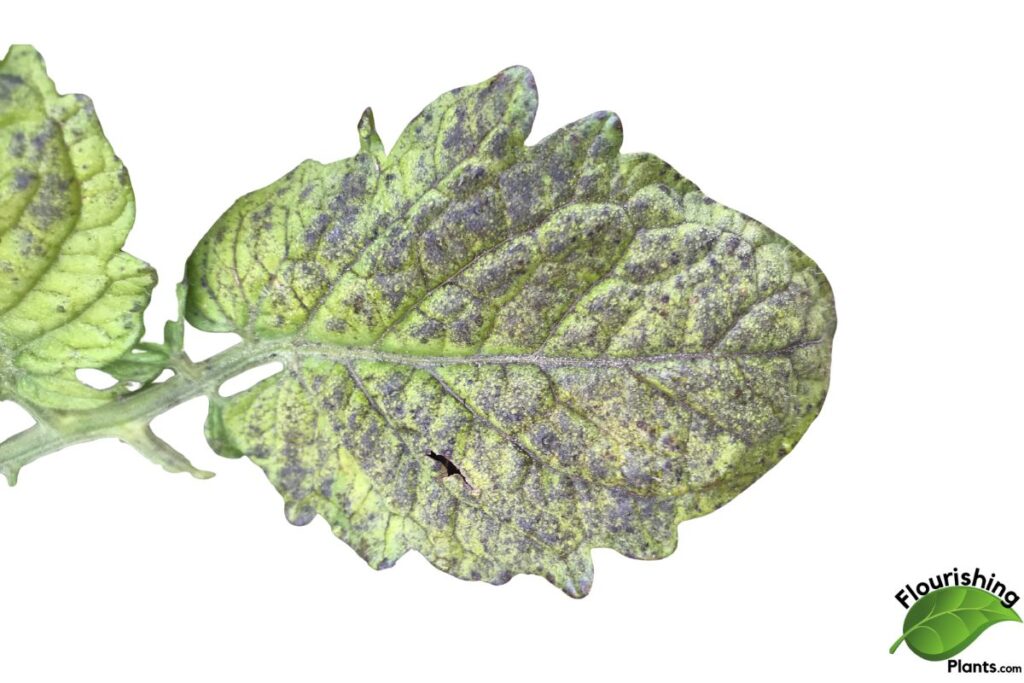
Blackening on tomato leaves is almost never random. Each cause leaves a distinct visual signature where it starts, what the spots look like, and how fast it spreads.
Knowing the pattern is the fastest route to the right fix. Treating late blight like overwatering, or blaming frost when blight is the real culprit, just wastes time.
Work through the seven causes below and match what you see to the description.
7 Causes of Tomato Leaves Turning Black
1. Late Blight Dark Water-Soaked Patches That Spread Fast
Late blight (Phytophthora infestans) is the most destructive disease on this list it’s the same pathogen responsible for the Irish potato famine.
It appears as large, dark greenish-grey or black water-soaked patches on leaves. The edges look greasy or wet even when the weather is dry. A white mould may appear on the underside of the leaf in humid conditions. It spreads with terrifying speed an entire plant can collapse in under a week.
Just as with holes on rose leaves, late blight spreads fastest when you leave damaged or infected tissue on the plant too long without acting.
How to fix late blight
- Remove infected material immediately: Cut off every affected leaf and stem, placing clippings directly into a sealed bag never the compost pile.
- Apply a copper-based fungicide: Mix copper fungicide at the label rate (typically 1 – 2 tablespoons per gallon of water) and spray the entire plant, covering both leaf surfaces thoroughly.
- Repeat on a 7-day schedule: Reapply every 7 days and after any rainfall until new growth comes in clean.
- Improve airflow: Stake or cage plants so leaves don’t touch each other or the ground, which cuts humidity at the leaf surface.
- Water at the base only: Switch to drip irrigation or direct soil watering never overhead sprinklers during late blight outbreaks.
2. Early Blight Black Concentric Rings Starting on Lower Leaves
Early blight (Alternaria solani) typically starts on the oldest, lowest leaves first and works its way upward. The signature is a dark brown or black spot with concentric rings like a target or bullseye surrounded by a yellow halo.
Unlike late blight’s rapid collapse, early blight progresses slowly. That gives you time to intervene. The pattern of concentric black rings is similar to black spots on rose leaves caused by Diplocarpon rosae both are fungal, both spread upward in humid conditions, and both respond to the same copper and neem treatments.
How to fix early blight
- Strip affected lower leaves: Remove all leaves showing the bullseye pattern, starting from the bottom of the plant and working upward.
- Apply a fungicide: Use a copper-based or chlorothalonil fungicide at label strength; spray every 710 days throughout the growing season.
- Mulch the soil surface: Lay 2 – 3 inches of straw or wood chip mulch around the base to stop fungal spores in the soil from splashing back up onto leaves during rain or watering.
- Rotate crops next season: Do not plant tomatoes (or potatoes or peppers) in the same bed for at least 2 – 3 years to break the spore cycle.
3. Bacterial Speck Tiny Black Spots with Yellow Halos
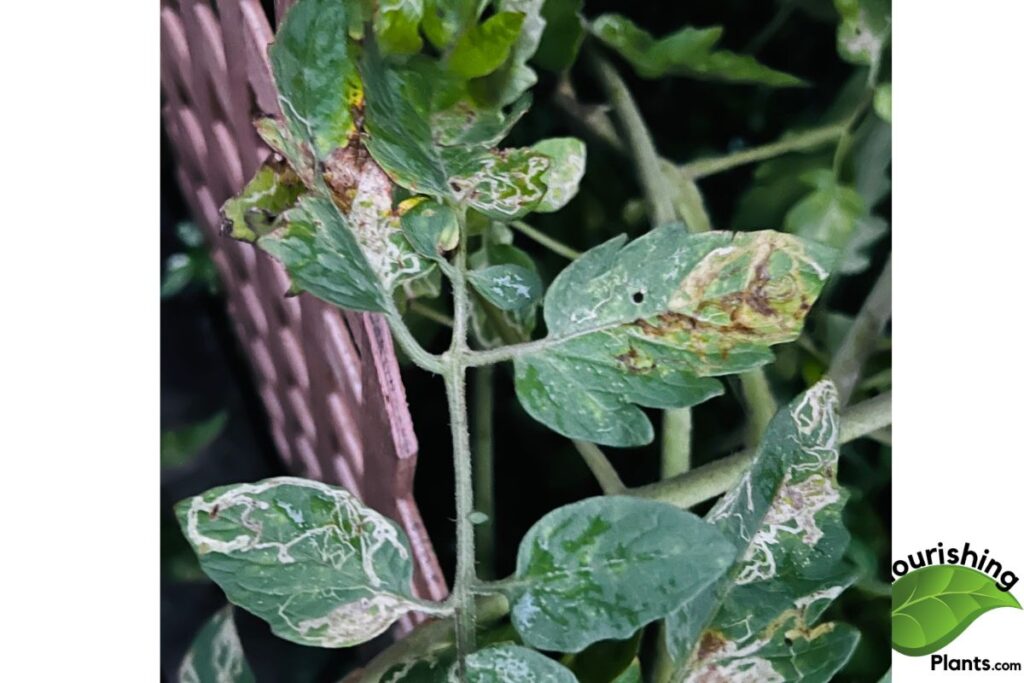
Bacterial speck (Pseudomonas syringae pv. tomato) creates very small, raised black spots typically 1 – 3 mm each surrounded by a yellow halo. Unlike fungal spots, these don’t develop concentric rings. They tend to appear after cool, wet weather and can affect the fruit surface too, leaving small scabby marks.
If you’re seeing spots on tomatoes, it’s worth ruling out whether you also have white spots on tomato leaves powdery mildew and bacterial issues sometimes appear at the same time when conditions are damp and close.
How to fix bacterial speck
- Remove heavily spotted leaves: Prune off any leaf with more than a third of its surface covered, and dispose of them in sealed bags.
- Apply a copper bactericide: Copper-based sprays work against bacterial speck as well as fungal diseases apply at label rate every 7 days during wet spells.
- Avoid working with wet plants: Bacteria spread on your hands and tools; only prune or stake plants when the foliage is dry.
- Disinfect tools between plants: Wipe pruners and scissors with 7 – 0% isopropyl alcohol between each plant to stop cross-contamination.
4. Frost Damage Overnight Blackening After Cold Snap
Frost damage is one of the easiest causes to diagnose because of its timing: the blackening appears the morning after a cold night, and it’s usually uniform across the plant rather than scattered in spots.
Tomato leaves turn black after frost because ice crystals rupture cell walls. New growth and leaf tips blacken first. The damage looks dark, limp, and papery rather than spotty or water-soaked.
How to fix frost damage
- Do not prune immediately: Wait 4872 hours after the frost event before cutting anything you need to let the full extent of damage reveal itself before trimming.
- Cut back to living tissue: Once the dead zones are clear, prune back to firm, green stem tissue using clean scissors.
- Hold off on fertilising: Don’t push growth with nitrogen fertiliser right after frost damage let the plant stabilise first for 1 – 2 weeks.
- Protect against further frosts: Cover plants overnight with horticultural fleece or an old bedsheet whenever temperatures are forecast below 5 – 0°F (1 – 0°C).
5. Septoria Leaf Spot Small Black Dots on Older Leaves
Septoria (Septoria lycopersici) starts on lower, older leaves and moves upward. The spots are smaller than early blight typically 3 – 5 mm circular, with a dark brown or black border and a pale grey or tan centre. You’ll often see tiny dark specks inside the pale centre (these are the fungal fruiting bodies called pycnidia).
Like early blight, it’s favoured by warm, wet conditions and spreads through soil splash.
How to fix septoria leaf spot
- Remove all infected leaves: Prune aggressively from the base upward, removing every leaf showing pale-centred spots.
- Apply a fungicide: Copper fungicide or chlorothalonil sprayed every 710 days slows and stops septoria spread; begin at first signs, not after the plant is heavily infected.
- Stake and thin for airflow: Tie stems to supports and remove any crossing or crowded shoots so air moves freely through the canopy.
- Avoid overhead watering: Water directly at soil level to keep foliage dry septoria spores need free moisture on the leaf to germinate.
6. Calcium Deficiency Black Edges on New Growth

Calcium deficiency shows up differently from every other cause on this list it hits the newest growth first, not the oldest. You’ll see black or dark brown scorched edges and tips on young leaves at the top of the plant. The rest of the leaf may look green and healthy.
It’s also linked to blossom end rot on the fruit (a classic black sunken patch on the bottom of tomatoes). Calcium deficiency is often less about soil calcium levels and more about inconsistent watering irregular moisture prevents the roots from absorbing calcium even when it’s present.
How to fix calcium deficiency
- Water consistently: Aim for even soil moisture let the top inch dry out, then water deeply. Boom-and-bust watering is the number-one cause of calcium lockout.
- Apply a calcium foliar spray: Mix a calcium chloride solution at 1 – 2 teaspoons per gallon and spray the new growth every 5 – 7 days for 3 – 4 weeks.
- Add lime or gypsum to the soil: Work in garden lime (dolomitic or calcitic) at the manufacturer’s recommended rate per square foot if soil pH is below 6.2 low pH blocks calcium uptake.
- Mulch to stabilise moisture: A 2 – 3 inch layer of mulch at the base dramatically evens out soil moisture swings between rain and dry spells.
7. Overwatering and Root Rot Black Wilting Leaves from Bottom Up

Overwatered tomatoes drown their own roots. When roots rot, they can’t deliver water or nutrients to the plant so leaves wilt, yellow, and eventually turn black even when the soil is soaking wet. You’ll typically see the lower leaves affected first, the stems may look dark or slimy at soil level, and the plant will look collapsed and sad despite saturated soil.
I use a 3-in-1 soil moisture meter from Amazon to catch overwatering before it causes root rot and black leaves it shows soil moisture, pH, and light levels simultaneously, which takes the guesswork out of watering.
If your plant is also showing curling or cupping alongside the blackening, read my guide on tomato leaves curling overwatering is one of the top triggers for both symptoms appearing together.
How to fix overwatering and root rot
- Stop watering immediately: Let the soil dry out to at least 2 inches deep before watering again; insert a finger or a moisture meter to check before every watering session.
- Improve drainage: If growing in containers, ensure there are multiple drainage holes and that the saucer is emptied after rain or watering never let pots sit in standing water.
- Remove rotted roots: If root rot has set in, gently unpot the plant, trim off all dark, mushy roots with sterile scissors, and repot into fresh, well-draining soil.
- Treat with hydrogen peroxide: Water the root zone once with a solution of 1 part 3% hydrogen peroxide to 4 parts water this introduces oxygen to the soil and kills anaerobic rot-causing pathogens.
- Amend future soil: Mix perlite into your potting or garden soil at a 1:4 ratio (perlite to soil) to improve drainage and prevent waterlogging recurring.
Quick Reference Table
| Cause | Where It Starts | Spot Pattern | Speed | Fix |
|---|---|---|---|---|
| Late Blight | Any leaf | Large, water-soaked, greasy edges | Very fast | Copper fungicide + remove tissue |
| Early Blight | Lower/older leaves | Bullseye rings + yellow halo | Moderate | Copper fungicide + mulch |
| Bacterial Speck | Any leaf | Tiny black dots + yellow halo | Moderate | Copper bactericide + dry handling |
| Frost Damage | New growth + tips | Uniform blackening, limp, papery | Overnight | Prune dead tissue + protect from cold |
| Septoria Leaf Spot | Lower/older leaves | Small spots, pale centre + dark border | Moderate | Copper fungicide + airflow |
| Calcium Deficiency | Newest growth | Black edges/tips on young leaves | Slow | Even watering + calcium spray |
| Overwatering/Root Rot | Lower leaves first | Wilting + general blackening | Slowmoderate | Reduce watering + improve drainage |
How to Prevent Black Leaves on Tomatoes
Once you’ve fixed the current problem, these habits will stop most causes of black tomato leaves from returning.
- Rotate your crops every 2 – 3 years. Never grow tomatoes, potatoes, or peppers in the same soil in consecutive years this breaks the lifecycle of blight, septoria, and early blight fungi that overwinter in the soil.
- Water at the base, never overhead. Direct your hose or watering can at soil level only. Wet foliage is the single biggest contributor to fungal and bacterial leaf diseases.
- Mulch generously around the base. A 2 – 3 inch layer of straw or bark mulch stops soil splash, retains even moisture, and reduces the spread of soil-borne fungal spores to lower leaves.
- Stake and prune for airflow. Thin out crowded stems and tie plants upright so air circulates freely through the canopy stagnant humid air is where fungal diseases breed.
- Monitor soil conditions closely. Check soil moisture before every watering, especially in containers. I use a 3-in-1 soil moisture meter from Amazon to avoid both overwatering and drought stress in one tool.
- Scout plants weekly for pests and eggs. Some insects carry fungal and bacterial pathogens between plants check the undersides of leaves regularly and read black eggs on leaves if you find anything unusual attached to the foliage.
- Apply cold-pressed neem oil every 710 days during humid weather. I spray cold-pressed neem oil concentrate from Amazon on my tomatoes every 710 days during warm, humid periods it prevents both fungal diseases and bacterial infections before they take hold, and it’s safe to use right up to harvest day.
The Bottom Line
Tomato leaves turning black is almost always diagnosable once you know what to look for. Most causes early blight, septoria, bacterial speck, calcium deficiency, and overwatering respond well to prompt action if you catch them early.
Late blight is the one that demands urgency. If you see large, greasy, dark patches spreading fast, treat within 2 – 4 hours and remove every infected leaf immediately.
Consistent watering, good airflow, soil-level irrigation, and a regular neem oil preventive spray will protect your plants through even the most humid summers.
The single most important thing you can do for your tomatoes is water consistently at soil level, keep foliage dry, and check your plants every few days because the earlier you catch any of these seven problems, the easier they are to fix.
About the author: JayLea has been growing vegetables, herbs, and houseplants for over a decade in containers, raised beds, and everything in between. FlourishingPlants.com exists to share practical, experience-based answers that help home gardeners fix problems fast and grow with confidence.
Related Posts:
- Holes on Rose Leaves
- Holes in Tomato Leaves
- White Spots on Tomato Leaves
- Tomato Leaves Curling
- White Lines on Tomato Leaves
Related Articles
Pepper leaves curling? Learn the 7 most common causes — from underwatering and heat stress to aphids and viral disease — plus step-by-step fixes to help your plants recover fast.
Pepper Leaves Turning Yellow: Why It Happens and How to Fix It
Pepper plant leaves turning yellow? Learn the 7 most common causes — from nitrogen deficiency to overwatering — and get specific, actionable fixes to bring your pepper plants back to health.