
You’re out checking on your tomato plants, feeling good about the season and then you flip over a leaf and find a cluster of tiny white bugs. Or maybe you notice a sticky film on the stems, or little cotton-like dots that weren’t there yesterday.
It’s an unsettling find, especially when your tomatoes are so close to producing. But don’t panic just yet.
White bugs on tomatoes are most commonly whiteflies, aphids (which can appear pale or white), or mealybugs. Whiteflies cluster under leaves and fly up in a cloud when disturbed; aphids gather on new growth and leaf undersides, sometimes appearing yellowish-white; and mealybugs look like tiny cotton dots on stems and joints. All three are manageable with insecticidal soap spray, neem oil applied every 5 – 7 days, or natural predators like ladybugs and lacewings introduced to your garden.
Before you reach for a spray bottle, it helps to know exactly which bug you’re dealing with. Each one has a slightly different habit and responds best to a slightly different approach.
Let me walk you through how to identify the culprit, fix the problem, and stop it from coming back.
What’s Causing White Bugs on Your Tomato Plants?
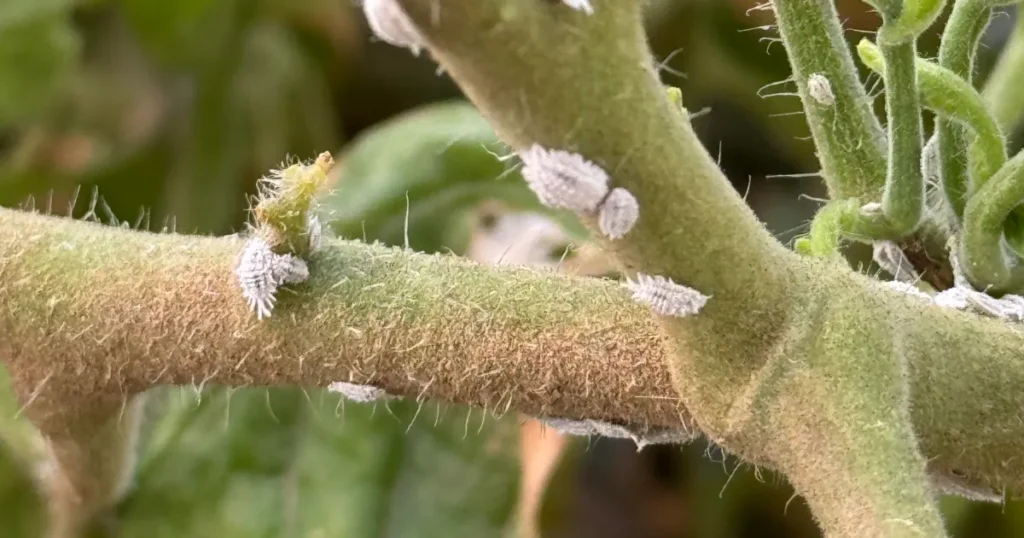
There are three main culprits behind white bugs on tomatoes. They look different up close and behave differently on the plant which makes identification your first step toward fixing the problem.
Whiteflies
Whiteflies are the most classic answer to “white bugs on tomatoes.” They’re tiny about 1 – 2 mm with white powdery wings, and they tend to live on the undersides of leaves in large groups.
The biggest giveaway? Disturb the plant even slightly and they erupt into a small white cloud, then resettle within seconds. You might also notice yellowing leaves, a sticky residue called honeydew on the stems and fruit, or sooty black mold developing on top of that stickiness.
Whiteflies reproduce fast. A single female can lay 200400 eggs in her lifetime, which means a small infestation can explode within a couple of weeks in warm weather.
Aphids (Pale or White Varieties)
Aphids are soft-bodied, pear-shaped insects that come in many colors green, black, brown, and yes, pale yellow or white. The woolly aphid and the potato aphid in its lighter form can both appear almost white on tomato plants.
They tend to cluster on new growth and the undersides of younger leaves, feeding on plant sap. Like whiteflies, they excrete honeydew, which attracts ants and encourages sooty mold growth. If you see ants marching up and down your tomato stems, aphids are often the reason ants “farm” aphids for their honeydew and will actually protect them from predators.
Mealybugs
Mealybugs are waxy, oval-shaped insects coated in a white powdery or cottony substance. They tend to hide in the joints where leaves meet stems, making them easy to miss until the population is well-established.
Unlike whiteflies, mealybugs don’t fly. They move slowly and tend to cluster in sheltered spots. The white fluff is the most distinctive sign it can look almost like someone sprinkled cotton fibers on your plant.
If you’ve ever noticed something that looked like white mold in a tight corner of your tomato plant, it might actually be mealybugs.
While you’re examining your tomato plants closely, it’s also worth checking your soil. Unrelated white critters occasionally show up underground if you spot anything pale and worm-like in your container mix, check out this guide on white worms in your soil to figure out whether they’re harmful or harmless.
How to Identify Which Bug You Have
Getting the ID right before you treat saves time and product. Here’s what to look for:
| Bug | Where It Lives | Key Visual | Movement |
|---|---|---|---|
| Whitefly | Leaf undersides | White powdery wings, tiny | Flies up in a cloud when disturbed |
| Pale Aphid | New growth, leaf undersides | Soft, pear-shaped, pale yellow-white | Slow crawl; ants nearby |
| Mealybug | Stem joints, crevices | White cotton-like fluff | Very slow; barely moves |
Check the undersides of leaves first. That’s where all three pests prefer to hang out, since it protects them from rain and direct sun.
A magnifying glass helps even a cheap one because these bugs are small enough that you can misread what you’re looking at with the naked eye.
How to Fix It: Treatments That Work
Step 1: Remove Heavily Infested Leaves
Start by pruning:
If a leaf or stem is heavily coated, remove it completely and drop it into a sealed bag before disposal. Don’t compost it you’ll just spread the infestation.
This alone doesn’t solve the problem, but it immediately reduces the population you’re treating.
Step 2: Spray with Insecticidal Soap Solution
Mix and apply:
Combine 1 – 2 teaspoons of pure liquid castile soap (like Dr. Bronner’s) with 1 quart of water. Shake gently and spray directly on the bugs, making sure to coat the undersides of leaves thoroughly.
The soap disrupts the insects’ outer coating and kills them on contact. It doesn’t leave behind a residue that continues working, so you need to hit the bugs directly.
Repeat every 3 – 5 days for two to three weeks. Missing a cycle gives eggs a chance to hatch and restart the cycle.
Step 3: Apply Neem Oil
Spray in the evening:
Mix 2 tablespoons of neem oil + 1 teaspoon of dish soap + 1 quart of warm water. Apply in the evening to avoid burning leaves in direct sun and to minimize impact on pollinators.
Neem oil works differently from soap it disrupts the insect’s ability to feed and reproduce, and it provides residual protection for several days. Apply every 5 – 7 days for 2 – 3 weeks.
I finish most tomato pest-prevention routines with a light neem oil spray every 5 – 7 days it’s become my go-to for keeping whiteflies and aphids under control.
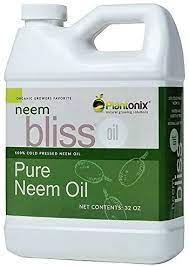
I use bliss pure neem oil from Amazon for a great price. It works great when it comes to shining leaves and provides a layer of protection for plants against common pests.
For whiteflies specifically, neem is particularly effective because it also targets eggs and larvae, not just adult insects.
Step 4: Use a Strong Water Blast
Knock them off:
A firm spray of plain water from a garden hose works surprisingly well for aphids and whiteflies. Focus on the undersides of leaves. Do this in the morning so the plant dries before evening.
It won’t eliminate the infestation on its own, but combined with soap or neem oil, it significantly speeds up recovery.
Step 5: Introduce Natural Predators
Release beneficials:
Ladybugs, lacewings, and parasitic wasps are all natural predators of these pests. Ladybugs alone can eat up to 5,000 aphids in their lifetime. You can purchase them from garden centers or online retailers.
Release them in the evening near the infested plants, and make sure you’ve stopped spraying insecticides for at least 4 – 8 hours before releasing them you don’t want to kill your allies.
Tip: Planting companion flowers like marigolds, basil, and nasturtiums near your tomatoes helps attract beneficial insects naturally, giving you ongoing biological control all season.
Quick Reference Diagnosis Table
| Symptom You’re Seeing | Most Likely Cause | First Fix |
|---|---|---|
| White cloud flies up when you touch leaves | Whiteflies | Neem oil every 5 – 7 days |
| Ants on stems + sticky residue | Aphids | Insecticidal soap + water blast |
| Cotton-like tufts in stem joints | Mealybugs | Rubbing alcohol on a cotton swab |
| Yellowing leaves + white bugs underneath | Whiteflies or aphids | Soap spray + remove affected leaves |
| Sooty black mold on leaves | Aphids or whiteflies (honeydew) | Treat bugs first, then wipe mold |
One note on mealybugs specifically: for small or isolated infestations, dipping a cotton swab in 7 – 0% isopropyl alcohol and dabbing it directly on each mealybug is one of the most effective spot treatments you can do.
How to Prevent White Bugs on Tomatoes
Prevention is always easier than treatment, and a few simple habits go a long way.
Check your plants weekly. Flip a few leaves every time you water. Catching five aphids is very different from catching five hundred.
Water and fertilize consistently. Stressed plants are more vulnerable to pest attacks. A tomato plant getting irregular water or insufficient nutrients is a much easier target than a healthy, vigorous one.
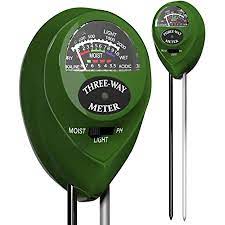
I also keep a soil moisture meter on hand when treating pest infestations, since stressed plants from inconsistent watering are much more vulnerable to these bugs.
Take the guesswork out of watering plants and keeping the soil moist. It is both cost-effective and durable.
Best of all, it also measures pH and light. It’s worth a look.
Avoid over-fertilizing with nitrogen. High-nitrogen fertilizer encourages the soft, lush new growth that aphids love. Stick to a balanced or slightly phosphorus-heavy fertilizer once your tomatoes start flowering.
Remove dead or yellowing leaves promptly. Debris on the plant creates hiding spots and spreads disease. While you’re at it, check the soil surface too some pests overwinter in the top layer of soil. If you’ve noticed anything odd in your potting mix, like white balls in your soil, those are typically fertilizer prills and harmless, but it’s good to know what you’re looking at.
Keep the garden tidy. Weeds near your tomatoes can harbor pests that migrate onto your plants. A clean garden edge makes a real difference over the course of a season.
One last thing: don’t be too quick to assume every bug is a problem. Not everything in your garden is an enemy. Some insects break down matter and actually return value to the soil in fact, dead bugs can actually add nutrients to soil as part of the natural decomposition cycle. The goal is balance, not a sterile garden.
When to Worry
Most whitefly, aphid, and mealybug infestations on tomatoes are fully controllable with consistent home treatment. But there are a few situations where you should act quickly or consider stronger intervention:
If the infestation has spread to multiple plants despite two or three rounds of treatment, the population may be larger than contact sprays can handle. In that case, consider a systemic insecticide labeled for edible crops and always follow label directions carefully.
If you’re seeing significant fruit distortion, stunted growth, or widespread leaf curl, the feeding damage is already impacting your yield. Prioritize aggressive treatment and remove the most affected plant parts immediately.
If you notice mosaic-like patterns or mottled coloring on leaves, whiteflies and aphids can both transmit plant viruses. There’s no cure for viral infection infected plants should be removed and disposed of (not composted) to prevent spread.
Frequently Asked Questions
Can white bugs on tomatoes harm the fruit itself?
Yes, indirectly. These pests feed on plant sap, which weakens the plant and can reduce fruit size, cause blossom drop, and leave fruit deformed. Whiteflies can also transmit tomato viruses that affect the whole plant.
Is it safe to eat tomatoes from an infested plant?
If you’re not using chemical pesticides and the fruit looks normal, it’s generally safe wash it thoroughly first. If you’ve applied insecticides, follow the product’s pre-harvest interval (the label will specify how many days must pass before harvest).
How long does it take to get rid of whiteflies on tomatoes?
With consistent treatment (every 3 – 7 days), most infestations clear up within 3 – 4 weeks. Skipping treatments gives the remaining population time to recover.
What attracts white bugs to tomatoes in the first place?
Warm temperatures, stressed or over-fertilized plants, and dense planting that reduces airflow are the main attractors. Whiteflies in particular thrive in hot, still conditions.
Can I use hydrogen peroxide on my tomato plants to treat bugs?
A diluted hydrogen peroxide spray (1 part 3% hydrogen peroxide to 3 parts water) can help with some surface pests and soil-borne issues, though it’s less targeted than insecticidal soap for whiteflies and aphids. It’s more commonly used for root health.
Do yellow sticky traps help with whiteflies?
Yes yellow sticky traps are a useful monitoring and population-reduction tool for whiteflies. They won’t eliminate a large infestation on their own, but they help you track numbers and reduce adults between spray treatments.
The Bottom Line
White bugs on tomatoes are almost always one of three things: whiteflies, pale aphids, or mealybugs. Each one is identifiable by where it lives on the plant and what it leaves behind and each one responds well to the same core treatment plan: remove affected growth, spray with insecticidal soap or neem oil on a consistent schedule, and bring in natural predators to help maintain control.
The most important thing is consistency. These pests reproduce quickly, and a missed week of treatment can undo real progress. Catch them early, treat regularly, and keep your plants healthy between treatments, and your tomato crop will recover.
A healthy tomato plant with weekly pest checks, regular neem oil or soap sprays, and a few companion plants nearby is well-equipped to fend off most white bug infestations before they cause serious damage.
Related Posts
- White Lines on Tomato Leaves: Causes, Treatment & Prevention
- Using Banana Peel Water for Your Tomatoes
- How to Prune Your Tomato Plants
- White Worms in Soil: What They Are and What to Do
Related Articles
Pepper leaves curling? Learn the 7 most common causes — from underwatering and heat stress to aphids and viral disease — plus step-by-step fixes to help your plants recover fast.
Pepper Leaves Turning Yellow: Why It Happens and How to Fix It
Pepper plant leaves turning yellow? Learn the 7 most common causes — from nitrogen deficiency to overwatering — and get specific, actionable fixes to bring your pepper plants back to health.