
You walk out to check on your tomato plants and something is off. The leaves are yellowing from the bottom up, the soil smells a little sour, and one of your seedlings just collapsed at the base overnight. Sound familiar?
Before you reach for an expensive fungicide or pull the whole plant out, there is a good chance the bottle of 3% hydrogen peroxide already sitting in your bathroom cabinet can save it.
Hydrogen peroxide helps tomatoes by oxygenating waterlogged soil, killing root rot pathogens, treating fungal leaf diseases like early blight, sterilising seeds before planting, boosting germination, and controlling pests like fungus gnats and aphids. The standard mix for most tomato uses is 1 part 3% hydrogen peroxide to 4 parts water, applied as a drench or spray depending on the problem and yes, every issue on this list is solvable at home.
The trick is matching the right ratio to the right problem. Too weak and you waste your time; too strong and you risk burning roots or leaves. Below is exactly how to use hydrogen peroxide on tomatoes for nine common problems, with the mixing ratios and timing for each.
Why Hydrogen Peroxide Works on Tomato Plants
Hydrogen peroxide (H‚‚O‚‚) is just water (H‚‚O) with one extra oxygen atom attached. That extra oxygen is what does all the work.
When you apply diluted peroxide to soil, that extra oxygen molecule breaks away and releases into the root zone. It oxygenates roots that are suffocating in wet soil, and it destroys the cell walls of fungi, bacteria, and soft-bodied pests on contact.
After a few minutes, the leftover hydrogen peroxide breaks down into plain water leaving no residue, no salt buildup, and nothing to harm your tomatoes. That is why it works so well as a quick, natural treatment.
For a wider look at every plant use beyond tomatoes, see our full guide to using hydrogen peroxide on plants.
Important: every ratio on this page uses 3% hydrogen peroxide the standard brown-bottle drugstore strength. Never use food-grade 3 – 5% peroxide undiluted; it will burn your plants.
The 9 Best Uses of Hydrogen Peroxide on Tomatoes
1. Treating Root Rot in Tomato Plants
Root rot is the number one tomato killer in containers and poorly drained beds. By the time leaves yellow and wilt, the roots are already brown and mushy.
What it does: Releases oxygen directly into the root zone, killing the anaerobic fungi (mostly Pythium and Phytophthora) that cause rot.
Signs you have it: Yellowing lower leaves, wilting despite wet soil, a sour smell from the pot, and dark mushy roots when you check.
Why it works: Rot pathogens thrive without oxygen. A peroxide drench floods them out and gives surviving roots a chance to recover.
How to treat tomato root rot:
- Mix 1 part 3% hydrogen peroxide with 4 parts water (about 1 cup peroxide to 4 cups water).
- Let the soil dry out as much as possible first do not drench wet soil.
- Slowly pour the solution at the base until it runs out the drainage holes.
- Repeat every 5 – 7 days for 2 – 3 weeks, allowing soil to dry between treatments.
- If the plant is in a pot, repot into fresh, well-draining mix after the second treatment.
If your soil also smells sour or musty, that is a sign of anaerobic conditions you can read more about in our guide to why potted plant soil smells bad.
2. Aerating Compacted or Waterlogged Soil
Compacted soil suffocates tomato roots even without disease. A peroxide drench is the fastest way to restore oxygen until you can fix the underlying drainage.
What it does: Floods the soil with extra oxygen, breaking up the anaerobic pockets that build up after heavy rain or overwatering.
When to use it: After several days of rain, after accidental overwatering, or when soil feels heavy and crusts on top.
Why it works: The oxygen released as the peroxide breaks down acts like a temporary aeration boost for stressed roots.
How to aerate tomato soil with hydrogen peroxide:
- Mix 1 tablespoon of 3% hydrogen peroxide per 1 cup of water for a light treatment.
- For heavier compaction, use 1 part peroxide to 4 parts water.
- Apply at the base of each plant until lightly soaked, not soggy.
- Use once per week for up to 3 weeks, then stop.
- Mix in compost or perlite long-term to keep the soil structure loose.
If you are also seeing the soil rise up or float when you water, our post on why soil floats and how to fix it covers the underlying fixes.
3. Sterilising Tomato Seeds Before Planting
Many tomato diseases including bacterial canker and early blight are seed-borne. A short peroxide soak kills surface pathogens before they ever reach your soil.
What it does: Disinfects the outer seed coat without damaging the live seed inside.
When to use it: Always for saved seeds; recommended for any store-bought seeds from older or unsealed packets.
Why it works: Peroxide destroys bacteria and fungal spores on contact but breaks down before it can penetrate the seed embryo.
How to sterilise tomato seeds:
- Mix 1 tablespoon of 3% hydrogen peroxide with 1 cup of warm water (around 3 – 5°C / 9 – 5°F).
- Submerge seeds for 510 minutes no longer.
- Drain and rinse thoroughly under cool running water.
- Spread seeds on a paper towel to dry for 1224 hours before sowing.
- Sow as usual.
4. Boosting Tomato Seed Germination
A diluted peroxide soak does more than disinfect it softens the seed coat and signals germination to start sooner.
What it does: Triggers faster, more uniform sprouting by helping water and oxygen reach the embryo.
When to use it: Right before sowing, especially with older saved seeds or slow varieties like heirloom beefsteaks.
Why it works: Oxygen is a key trigger for the metabolic processes inside a dormant seed. Peroxide gives a small, controlled oxygen boost.
How to pre-soak tomato seeds for faster germination:
- Mix 1 teaspoon of 3% hydrogen peroxide with 1 cup of warm water.
- Soak seeds for 4 – 6 hours (or overnight for very old seeds).
- Drain do not rinse this time.
- Sow immediately into pre-moistened seed-starting mix.
- Expect germination 1 – 3 days earlier than untreated seeds.
5. Preventing Damping-Off in Tomato Seedlings
Damping-off is the heartbreak of seed-starting season seedlings sprout, then collapse at the soil line overnight. It is caused by soil-borne fungi that thrive in wet, cool conditions.
What it does: Kills the fungal pathogens (Pythium, Rhizoctonia, Fusarium) at and just below the soil surface.
When to use it: As a preventative when seedlings first emerge, and at the first sign of any seedling collapsing.
Why it works: Damping-off fungi live in the top centimetre of soil. A light peroxide spray reaches them without harming young roots.
How to prevent damping-off in tomato seedlings:
- Mix 1 teaspoon of 3% hydrogen peroxide with 1 cup of water.
- Mist the soil surface and base of the seedlings.
- Apply once a week from emergence until seedlings have 4 true leaves.
- Keep seedling trays well-ventilated and avoid overhead watering.
- If you see one seedling collapse, treat the whole tray immediately.
6. Treating Early Blight and Other Fungal Leaf Diseases
Early blight, Septoria leaf spot, and powdery mildew are the three most common fungal diseases on tomato leaves. A peroxide foliar spray catches them early before they spread to fruit.
What they look like: Dark concentric ring spots (early blight), small grey spots with dark borders (Septoria), or white powdery patches (powdery mildew).
What they do: Reduce photosynthesis, kill leaves from the bottom up, and eventually weaken fruit production.
What causes them: Wet leaves, poor airflow, splashing soil during watering, and humid nights.
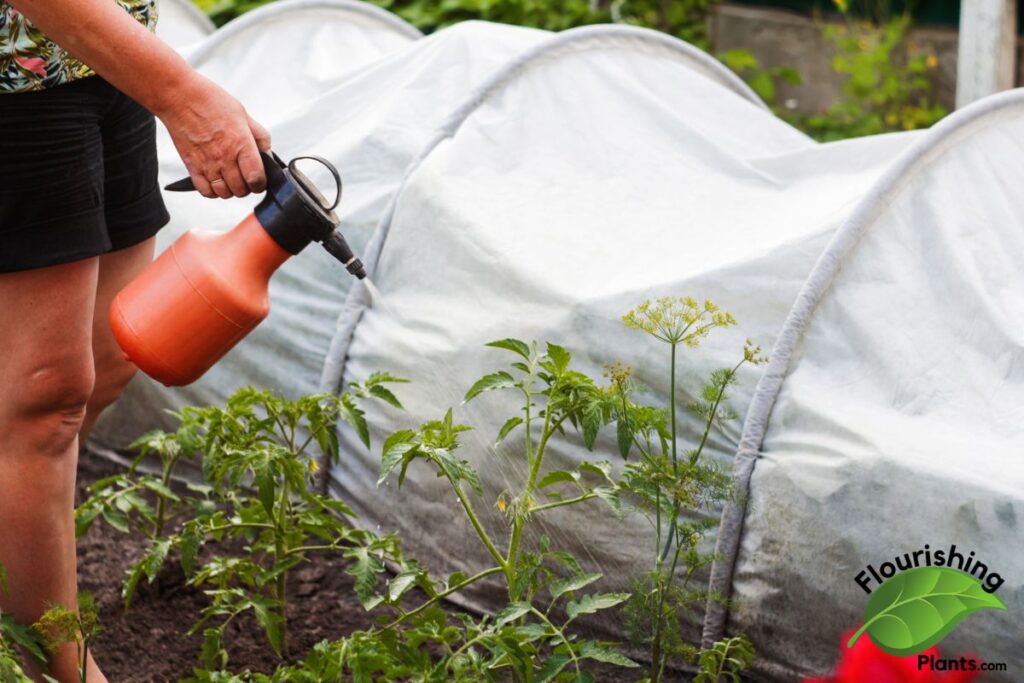
How to spray tomato leaves for fungal disease:
- Mix 1 tablespoon of 3% hydrogen peroxide with 1 cup of water.
- Pour into a clean spray bottle.
- Spray the tops and undersides of all leaves until lightly coated.
- Apply in the early morning or evening never in direct midday sun.
- Repeat every 4 – 5 days for 2 – 3 weeks, removing badly infected leaves between sprays.
For a milder alternative or a rotation partner, vinegar diluted at the right strength also works against some fungal issues.
7. Getting Rid of Fungus Gnats in Tomato Soil
Fungus gnats are the tiny dark flies you see lifting off the soil when you water. The adults are annoying; the larvae are the real problem they eat young tomato roots.
What they look like: Adults are 2 – 3 mm long, dark grey-black, mosquito-like. Larvae are translucent white with a black head, found in the top 2 – 3 cm of soil.
What they do: Larvae feed on root hairs and decaying organic matter, stunting young tomato plants.
What causes them: Consistently wet topsoil and decaying matter in the mix.
How to kill fungus gnats with hydrogen peroxide:
- Let the top 2 – 3 cm of soil dry out completely first.
- Mix 1 part 3% hydrogen peroxide with 4 parts water.
- Drench the soil thoroughly you will hear it fizz as it kills the larvae.
- Repeat every 4 – 5 days for 2 weeks to break the breeding cycle.
- Cover the soil with a thin layer of sand or fine gravel to stop new eggs being laid.
8. Controlling Aphids and Whiteflies on Tomato Plants
Aphids and whiteflies are soft-bodied sap-suckers that cluster on new growth and leaf undersides. A peroxide spray dries them out on contact without leaving residue on fruit.
What they look like: Aphids are 1 – 3 mm, green, black, or pink, in dense clusters. Whiteflies are tiny white moths that lift off when you shake a leaf.
What they do: Suck sap, deform new growth, and spread viruses between plants.
What causes them: Stressed plants, dense foliage, and warm humid conditions.
How to spray tomatoes for aphids and whiteflies:
- Mix 1 tablespoon of 3% hydrogen peroxide with 2 cups of water.
- Add 2 – 3 drops of mild dish soap to help the spray stick.
- Spray the undersides of leaves and all new growth thoroughly.
- Apply early morning or after sunset, never in direct sun.
- Repeat every 3 – 4 days for 2 weeks until the population is gone.
9. Sanitising Pots and Pruning Tools
Many tomato diseases spread when you reuse pots or move between plants with the same pruners. A peroxide wipe-down between uses prevents that.
What it does: Sterilises surfaces by killing bacteria, fungi, and viruses without leaving harmful residue.
When to use it: Between pruning sessions, before reusing pots, and after handling a diseased plant.
Why it works: Peroxide kills pathogens on contact and evaporates clean no rinsing required.
How to sanitise tomato gardening tools:
- Use undiluted 3% hydrogen peroxide straight from the bottle.
- Wipe blades, scoops, and pot rims with a peroxide-soaked cloth.
- For pots, spray inside and out, then let air-dry for 1 – 0 minutes.
- Wipe pruner blades again after each plant when moving between sick plants.
- Store tools dry to prevent rust.
Tomato Hydrogen Peroxide Quick Reference Table
| Use | Ratio (with 3% H‚‚O‚‚) | How Often | Notes |
|---|---|---|---|
| Root rot drench | 1 part peroxide : 4 parts water | Every 5 – 7 days, 2 – 3 weeks | Let soil dry between treatments |
| Soil aeration | 1 tbsp per 1 cup water | Once a week, max 3 weeks | Mild routine boost |
| Seed sterilisation | 1 tbsp per 1 cup warm water | One 510 min soak | Rinse before sowing |
| Germination boost | 1 tsp per 1 cup warm water | One 4 – 6 hr soak | Do not rinse after |
| Damping-off prevention | 1 tsp per 1 cup water | Weekly until 4 true leaves | Mist soil surface |
| Fungal leaf disease spray | 1 tbsp per 1 cup water | Every 4 – 5 days, 2 – 3 weeks | Morning or evening only |
| Fungus gnats | 1 part peroxide : 4 parts water | Every 4 – 5 days, 2 weeks | Let topsoil dry first |
| Aphids / whiteflies | 1 tbsp per 2 cups water + 2 drops soap | Every 3 – 4 days, 2 weeks | Spray leaf undersides |
| Tool sterilisation | Undiluted 3% | Between uses | No rinse needed |
How to Prevent Tomato Root Rot and Fungal Problems
Hydrogen peroxide treats the problem, but prevention is what keeps your tomato plants healthy all season. The tips below stop almost every issue on this list before it starts.
- Water at the base, not from above. Wet foliage is the single biggest cause of fungal leaf disease. Use a watering can spout or drip line directed at the soil, not the leaves.
- Water deeply, less often. A deep weekly soak grows stronger roots than daily shallow watering. Let the top 2 – 3 cm of soil dry between waterings.
- Use a well-draining potting mix. For container tomatoes, mix in 2030% perlite or coarse sand so water never sits at the root zone. Standard potting soil alone holds too much water.
- Space plants for airflow. Crowded tomato plants stay damp longer after rain. Allow at least 6 – 0 cm (2 – 4 inches) between plants and prune lower leaves once the plant is 3 – 0 cm tall.
- Mulch to stop soil splash. A 2 – 3 cm layer of straw or shredded leaves prevents soil-borne fungal spores from splashing up onto leaves during watering or rain.
- Feed with potassium-rich amendments. Strong cell walls resist disease better. Banana peel water is a free, gentle way to add potassium throughout the growing season.
- Rotate where you plant tomatoes each year. Soil-borne pathogens build up over time. Move your tomato bed every year (or refresh container soil) on a 3-year rotation.
- Spray with diluted neem oil every 1014 days. A preventative neem oil mist 1 teaspoon neem oil plus 4 – 5 drops of mild soap in 1 litre of water keeps fungus, aphids, and whiteflies from ever taking hold. This is the single best natural preventative you can add to your tomato routine.
The Bottom Line
Hydrogen peroxide is one of the cheapest, safest, and most flexible tools you can keep in your garden cupboard.
A single 3% bottle from the drugstore can sterilise your seeds, save a rotting root system, knock back early blight, and clear out fungus gnats all without leaving harmful residue on your tomatoes.
The two rules that matter most: always use 3% strength (not food-grade), and always match the ratio to the problem. A 1:4 drench for soil rot is very different from a 1 teaspoon per cup mist for seedlings.
Used correctly, peroxide is a treatment not a cure-all. Pair it with good watering habits, airflow, and a neem oil prevention routine, and your tomato plants will rarely give you trouble.
The single most important thing to remember: hydrogen peroxide works because it adds oxygen, so it is most powerful exactly when your tomatoes need oxygen most in wet, suffocating soil or against disease on damp leaves.
Related Posts:
- Using Hydrogen Peroxide On Plants: 1 – 1 Uses & Mixing Ratios
- Banana Peel Water For Tomatoes: Why Tomato Plants Love It
- Using Vinegar On Plants: Correct Strength and Mixing Ratios
- Potted Plant Soil Smells Bad: Causes and Fixes
- Holes On Rose Leaves: The Known Culprits and Easy Fixes
Related Articles
Pepper leaves curling? Learn the 7 most common causes — from underwatering and heat stress to aphids and viral disease — plus step-by-step fixes to help your plants recover fast.
Pepper Leaves Turning Yellow: Why It Happens and How to Fix It
Pepper plant leaves turning yellow? Learn the 7 most common causes — from nitrogen deficiency to overwatering — and get specific, actionable fixes to bring your pepper plants back to health.