
Most gardeners pick basil the wrong way without even knowing it. The good news is that one small technique change turns a one-time harvest into a plant that produces all season long.
To pick basil leaves so they keep growing, pinch or cut just above a leaf node the point where two leaves branch off the stem removing the top 24 inches of each stem. This signals the plant to send out two new shoots from that node instead of one, doubling your harvest points over time. Always leave at least two sets of leaves on each stem, never strip a stem bare, and harvest in the morning after the dew dries for the best flavor and fastest regrowth.
Understanding why this works makes it easy to remember. Basil is a branching plant every time you cut a growing tip, the plant redirects energy into the two buds sitting just below the cut. Get that mechanic right, and you’ll have more basil than you know what to do with.
Why Basil Keeps Growing When You Cut It the Right Way
Before jumping into technique, it helps to understand what’s actually happening inside the plant.
Basil like most herbs is apically dominant. That means the main growing tip at the top of each stem releases hormones that suppress the side buds below it.
The moment you remove that top tip, those hormones disappear. The two buds directly below the cut wake up and grow into full stems, each of which will eventually produce their own side buds.
Cut the plant correctly three or four times through the season, and you go from a single-stemmed seedling to a multi-branched bush. Cut it wrong by pulling leaves off the middle or base and you slow this process considerably.
The same logic applies to keeping your other plants healthy. Just as pruning technique determines a plant’s future growth pattern, understanding how stress and damage spread through a plant helps you spot early trouble signs much like recognizing holes on rose leaves before they become a bigger problem.
The Right Way to Pick Basil Leaves
Step 1: Find the Leaf Nodes First
Look at your basil stem from top to bottom.
You’ll see pairs of leaves growing out of the stem at regular intervals. Each of those pairs is a “node.” Just above each node, nestled in the angle between the leaf stem and the main stem, you’ll see two tiny buds those are your new branches waiting to happen.
Your cut goes just above one of those nodes, about a quarter-inch up from the leaf pair.
Step 2: Decide How Much to Take
A general rule: take the top 24 inches of any stem that has at least 3 sets of leaves.
That leaves you with plenty of foliage below to keep the plant photosynthesizing and growing. If a stem only has two leaf sets, leave it alone for another week.
For a small plant you’ve just moved outdoors, take less just the very top pair of leaves and the growing tip. For a full, bushy plant mid-season, you can be more aggressive.
Step 3: Pinch or Cut Both Work
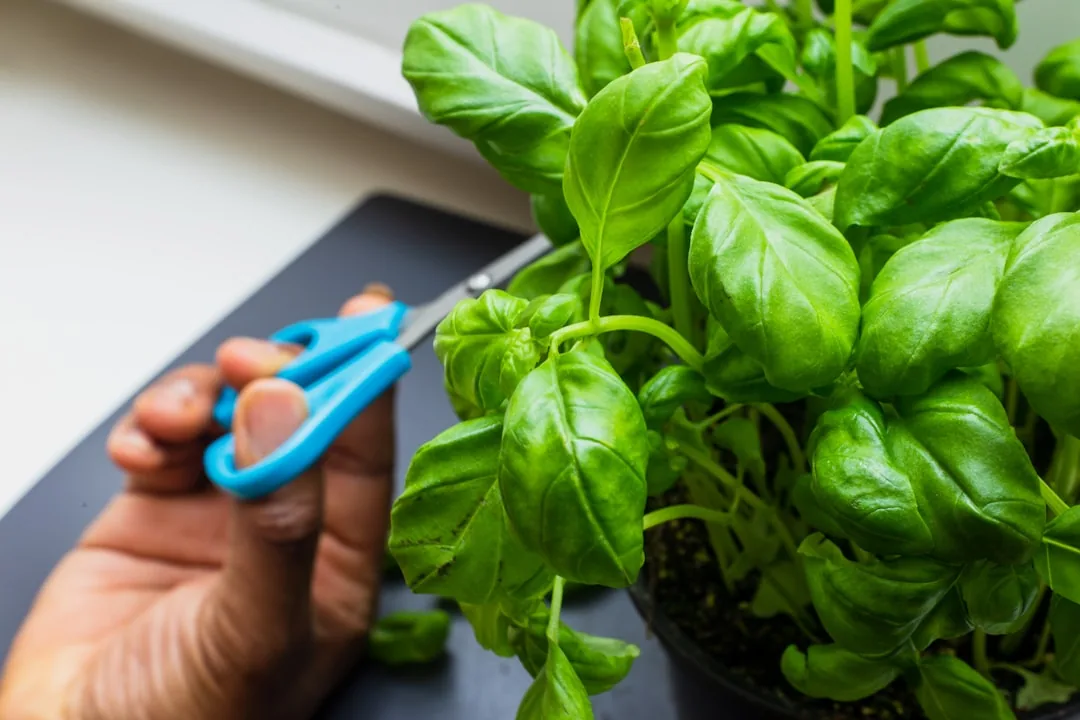
Use your fingernails or sharp scissors.
Pinching with your fingers works fine for soft, young growth just press your thumbnail against your index finger and snap the stem cleanly. For thicker, woodier stems (especially on basil that’s been growing for more than 68 weeks), use clean scissors or herb snips to avoid bruising the tissue.
Bruised stems can invite disease and slow healing, so the cleaner the cut, the better.
Step 4: Work Around the Whole Plant
Don’t just cut from one side.
Harvest from multiple stems across the plant, trimming evenly so it stays balanced and bushy. Think of it like a haircut you want the overall shape to stay compact, not lopsided.
Take from the tallest stems first. They’re the ones closest to bolting (going to seed), and cutting them back extends your harvest window considerably.
Step 5: Never Take More Than a Third at Once
The one-third rule applies here just as much as in lawn care.
Removing more than a third of the plant’s total foliage in a single session puts it under stress. You’ll see slower regrowth, and in hot weather the plant may bolt prematurely.
If your basil has gotten very tall and leggy, cut it back in stages over two weeks rather than all at once.
When to Harvest Basil
Time of Day
Harvest in the morning, after the dew has dried but before the midday heat.
The plant’s essential oils the compounds responsible for that intense, peppery-sweet flavor are at their highest concentration in the morning. Leaves picked in the afternoon, especially in high temperatures, tend to wilt faster and taste slightly less vibrant.
How Often to Harvest
Once a week is ideal for a mature plant.
That’s enough time for new shoots to develop after each cutting. In peak summer when basil is growing fast, you may find every five or six days is right.
If you’re growing basil primarily to prevent bolting rather than for big harvests, a light trim every 10 days keeps flower buds from forming.
Watch for Flower Buds Remove Them Immediately
This is the most important timing tip. Once basil starts to flower, it shifts all its energy from leaf production to seed production. The leaves get smaller, tougher, and less flavorful almost overnight.
The moment you see a flower spike forming at the top of a stem, pinch it off.
Don’t wait. This is called “deadheading,” and it resets the plant’s focus back to leaf growth. A plant you deadhead consistently can produce right through early autumn.
Caring for Basil Between Harvests
Getting the harvesting technique right is only half the equation. What you do between cuts determines how fast your plant bounces back.
Watering
Basil likes consistently moist not waterlogged soil. It wilts dramatically when dry, but sitting in soggy soil invites root rot just as fast. Check the top inch of soil daily in hot weather. If it’s dry, water deeply at the base of the plant, not on the leaves.
I keep a misting bottle handy when I’m harvesting a quick mist of the foliage after cutting helps the plant recover faster in hot weather.
This cost-effective and durable misting bottle will deliver a continuous and even supply of mist to your plant, ensuring that it is well watered through misting.

If you’re growing in containers, they dry out faster than garden beds. Check out our guide on how to keep soil moist for practical methods that reduce how often you need to water especially useful during summer heat waves.
Light
Basil needs a minimum of 6 hours of direct sun per day. Less than that and growth slows, stems stretch (etiolate), and the plant becomes weak and leggy between harvests. If your basil is indoors on a windowsill and the leaves are paling or reaching toward the light, it needs more sun or a grow light supplement.
Pale, washed-out foliage is often an early signal that something’s off similar to the pale leaves you might see on other indoor plants when light is inadequate.
Repotting
If your basil is root-bound roots circling the bottom of the pot, water running straight through without being absorbed it can’t grow fast enough to keep up with your harvesting. A root-bound plant between harvests won’t recover quickly.
Basil does best in a pot at least 68 inches in diameter. If you started from a small nursery pot, transplanting it up a size makes a significant difference in how aggressively it regrows. For a full walkthrough on timing and technique, our guide on repotting your plant covers the process step by step.
Fertilizing
Feed basil with a balanced liquid fertilizer (10-10-10 or similar) every 34 weeks during the growing season. Too much nitrogen will produce large, lush leaves with less flavor intensity so don’t overdo it. A light, regular feed is better than an occasional heavy dose.
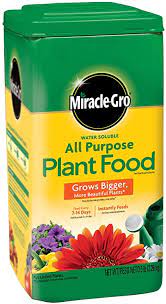
I feed my container basil with a balanced soluble fertilizer every 34 weeks during the growing season to keep it producing steadily between harvests.
This Miracle-Gro Soluble fertilizer has given me some really good results in keeping my plants happy and healthy. It’s great value for money and will last a long time. You can find it by clicking here.
Common Mistakes When Picking Basil
Pulling Leaves From the Middle of the Stem
This is the most common mistake. Pulling individual leaves from the lower or middle parts of the stem doesn’t trigger branching at the growing tip. You get a stripped-looking stem with no new growth points activated.
Always cut from the top down.
Leaving Stumps Too Long
Cutting too far above the node leaves a stub of bare stem that serves no purpose and can become an entry point for disease. Get your cut close about a quarter-inch above the node.
Harvesting an Immature Plant
A seedling with fewer than 6 leaves total isn’t ready to harvest. Let it grow to at least 68 inches tall with 3 or more leaf sets before taking anything. Early harvesting on a young plant sets it back significantly.
Not Watching for Pests
Healthy, frequently harvested basil is actually less vulnerable to pests because you’re monitoring it closely every week. But watch the undersides of leaves when you harvest aphids, spider mites, and whitefly all favor basil.
If you spot unusual residue or specks on your basil foliage while harvesting, it’s worth cross-checking with what you know about common leaf issues. For example, black eggs on leaves can look alarming but are often identifiable quickly once you know what you’re looking at. Similarly, if leaves are curling during periods of stress or heat, our post on plant leaves curling walks through the most likely causes.
Quick Reference: Do This, Not That
| Correct Technique | Common Mistake |
|---|---|
| Cut just above a leaf node | Pull leaves from the middle of the stem |
| Take the top 24 inches of each stem | Strip a stem completely bare |
| Harvest up to one-third of the plant at once | Take more than half in one session |
| Pinch flower buds immediately | Let the plant flower and go to seed |
| Harvest in the morning | Harvest in afternoon heat |
| Harvest weekly once mature | Harvest only when you need leaves |
Frequently Asked Questions
Can you pick basil leaves without cutting the stem?
Yes for just a few leaves, you can pinch individual leaves from the top of the stem without using scissors. But for regular harvests aimed at promoting regrowth, cutting just above a leaf node is always more effective. Leaf-by-leaf picking doesn’t trigger the same branching response.
How do I know when my basil plant is ready to harvest for the first time?
Wait until the plant has at least 6 leaves and is 68 inches tall. It should have at least three sets of leaf nodes visible on the main stem. The first harvest should be light just the top inch or two to encourage branching without stressing a young plant.
What happens if I let basil flower?
Once basil flowers, it enters its reproductive phase. Leaf production slows, existing leaves become smaller and more bitter, and the plant begins to die back after setting seed. Pinching flowers off as soon as they appear resets the cycle and keeps the plant in its productive vegetative phase.
Should I harvest the large bottom leaves or the top growth?
Always take from the top. Top growth contains the growing tips that are causing apical dominance. The large leaves at the base are the plant’s main solar panels removing them reduces photosynthesis and slows overall growth.
Can I harvest basil every day?
A light pinch every day removing just the very top tip or a flower bud won’t harm the plant. But a full harvest should be spaced at least 57 days apart to allow new growth to develop fully before you cut again.
The Bottom Line
Picking basil the right way takes about 30 seconds of extra attention locate a leaf node, cut just above it, and leave two or more sets of leaves on every stem. Do that consistently, deadhead the flowers before they open, and harvest in the morning, and you’ll have a plant that produces nonstop from early summer right through fall.
The biggest shift most gardeners make is from “grabbing what they need” to thinking about each cut as an investment in the next harvest. Once that clicks, basil becomes one of the most rewarding herbs you can grow.
Cut above the node, leave the lower leaves, remove the flowers and your basil will reward you with more than you can use all season long.
Related Posts
- Holes on Rose Leaves: What’s Causing Them and How to Fix It
- Plant Leaves Curling: Causes and Fixes
- Pale Plant Leaves: What They’re Telling You
- What Causes Sticky Plant Leaves
- How to Keep Soil Moist
Related Articles
Pepper leaves curling? Learn the 7 most common causes — from underwatering and heat stress to aphids and viral disease — plus step-by-step fixes to help your plants recover fast.
Pepper Leaves Turning Yellow: Why It Happens and How to Fix It
Pepper plant leaves turning yellow? Learn the 7 most common causes — from nitrogen deficiency to overwatering — and get specific, actionable fixes to bring your pepper plants back to health.